
Milk-drink workflow leans Niche Zero; light-roast experimentation leans DF64 Gen 2
If your usual drink is a latte, cappuccino, cortado, or americano with medium to medium-dark beans, the Niche Zero is the lower-risk fit. Treat that as a priority fit, not a proven head-to-head taste result: the Niche Zero’s conical burrs and simpler daily setup better match buyers who want repeatable prep and a fuller espresso style.
The DF64 Gen 2 makes more sense when experimenting with the coffee itself is the point. If you buy light roasts, naturals, fruity coffees, or rotate beans often, treat the DF64 Gen 2 as the stronger priority fit because its flat-burr platform and configuration flexibility suit clarity-focused experimenting.
That does not mean the DF64 Gen 2 will taste better for you. The two grinders serve different priorities. Pick the Niche Zero if you want rich, sweet-feeling, repeatable espresso without much tinkering, especially for milk drinks where body, ease, consistency, retention, and household noise may matter more than tasting-note separation. Pick the DF64 Gen 2 if you want to explore what each light, fruity, or natural-processed bean is doing and are willing to experiment rather than assume an upmarket grinder will automatically settle lighter roasts and pour-over compatibility for you.
If you brew filter coffee too, DF64 Gen 2 is easier to justify
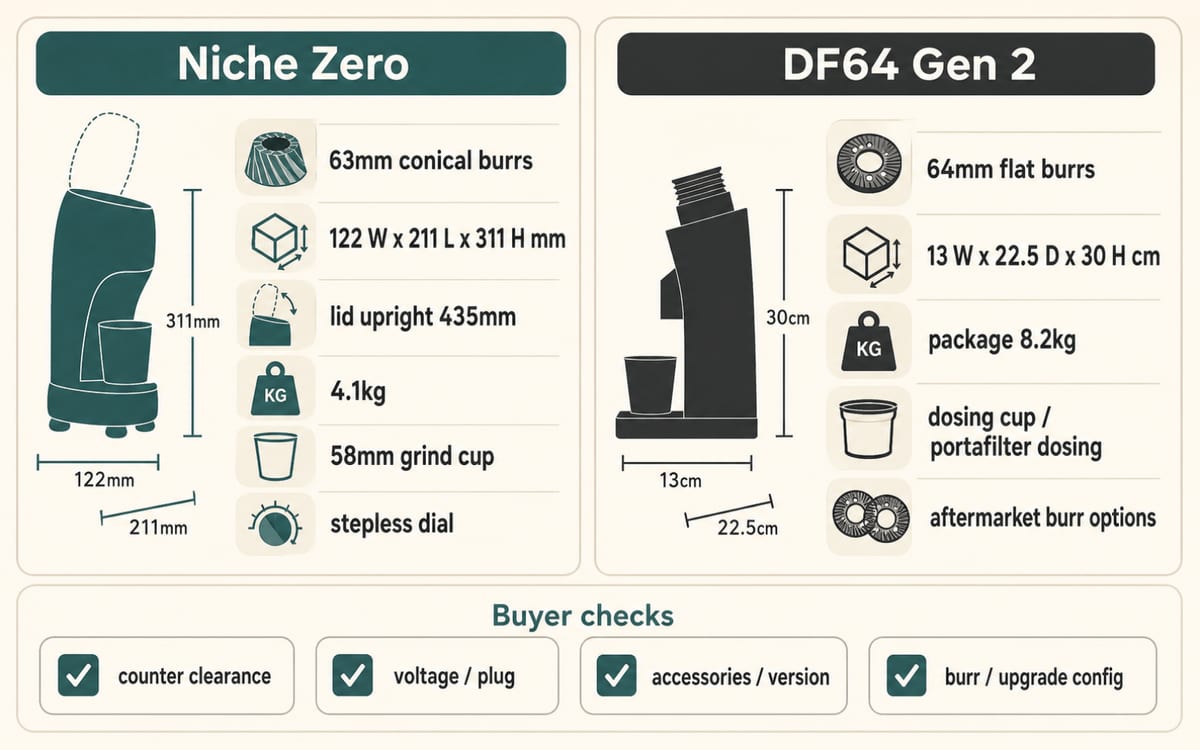
If one grinder has to move between espresso and filter coffee, the DF64 Gen 2 is easier to justify. Its listed brew-method range covers espresso, pour-over, V60, siphon, cold brew, French press, and drip, so it is the more natural pick for a counter where filter brewing is part of the week.
The Niche Zero is not espresso-only; its stepless dial can be moved for different brewing methods. The buyer question is whether filter is occasional or central. If espresso is the main job and filter is a side use, the Niche Zero remains a sensible, calmer choice. And if a separate grinder already handles your filter brewing and will stay on the counter, the DF64 Gen 2's brew-range advantage matters less - let the espresso side decide: daily steps, body versus clarity, and counter fit. If you already brew filter often, or you mostly brew filter now and plan to add espresso later, the DF64 Gen 2 gives you more reason to buy one grinder for both roles.
Do not treat brew-method range as a promise of better coffee by itself. Before buying, think about how often you will actually switch settings and whether you are comfortable returning to an espresso setting after filter use.
When your machine or portafilter limits the workflow
A compact 54mm machine such as a Bambino or Bambino Plus is a good example of why the grinder has to match the basket, dosing cup, portafilter prep, and roast style you actually use.
For a Bambino Plus used mostly for milk drinks, the Niche Zero is the simpler grinder-side fit for quick, textured espresso.
Choose the DF64 Gen 2 instead if the Bambino Plus is a stepping stone. If your longer-term plan is lighter roasts, bean comparison, filter overlap, or a future machine upgrade, the grinder becomes the part you may keep as your tastes change.
One practical note for smaller portafilter workflows: the Niche Zero includes a 58mm grind cup, while Bambino Plus-class machines use 54mm portafilter accessories. That is not a deal-breaker, but you should check the handoff from cup to portafilter. Make sure your dosing cup, funnel, basket, and portafilter line up with the way you actually prep shots.
Check counter space and daily fuss before choosing burr type
The better grinder on paper can still be the wrong one if it annoys you every morning. Owner discussions often turn practical: narrow coffee stations, small-counter aesthetics, household noise sensitivity, shipping, regional availability, local stock, and backorders can all become real constraints.
The DF64 Gen 2’s listed size is 22.5cm deep, 13cm wide, and 30cm high, which is worth checking against cabinets, shelves, and the space beside a Bambino Plus. The Niche Zero has a narrower footprint at 122mm wide and 211mm front to back, but it needs 435mm of clearance with the lid up, so check the shelf height above the grinder, not just the counter footprint.
Noise-sensitive buyers should look for comparable tests before treating either grinder as the quieter choice. Niche lists the Zero at 72dB during grinding. Without a like-for-like DF64 Gen 2 noise figure, do not assume one grinder is quieter than the other.
This is where the Niche Zero’s appeal is strongest. If the upgrade is mostly about easier mornings, multiple daily cups, or moving confidently into unpressurized baskets, fewer frustrating steps before coffee can matter more than a more flexible spec sheet. Owners coming from a hand grinder, an aging entry grinder, or a high-retention hopper grinder are often buying a calmer morning rather than a different-tasting cup - a recurring pattern is owners whose shots are already good but who want the single-dose convenience and a grinder that lasts; either grinder solves that, so decide by noise, footprint, and which steps annoy you less.
The DF64 Gen 2 is the better practical fit for someone who enjoys the grinder as part of the hobby. Extra setup parts and upgraded burr choices can be part of the appeal, but only if the listing makes clear whether stock burrs are included, what the upgrade adds to the price, and the configuration still makes sense for you; when a used premium grinder is the alternative, check its age, condition, burrs, and local availability before treating it as equivalent to a new grinder.
When to skip the Niche Zero or DF64 Gen 2
Skip the Niche Zero if you already know you want flat-burr experimentation, aftermarket burr options, and a grinder that can become a platform project. You may appreciate its simplicity and still wish you had chosen the more configurable DF64 Gen 2.
Skip or slow down on the DF64 Gen 2 if you do not want to compare standard, upgraded-burr, imported, and used listings before the price comparison is meaningful. It can be the better fit for clarity, filter overlap, and burr experimentation, but a standard package, upgraded-burr package, imported unit, or used unit can change the real price and warranty protection.
Also avoid treating either grinder as a magic upgrade, especially if your budget is really a ceiling rather than a target: owner cases around the under-$500 to under-$1000 range often turn on package contents, resale from the current grinder, shipping, backorders, local availability, and new-versus-used tradeoffs rather than the grinder name alone. If your current shots are already good enough and your frustration is rushed mornings, the better buy is the one that removes daily friction, not the one with the more exciting spec sheet.
Common Questions
Is the Niche Zero better than the DF64 Gen 2 for milk drinks?
It is the safer fit if your priority is simple, body-forward espresso for lattes, cappuccinos, cortados, and medium to medium-dark beans.
Is the DF64 Gen 2 better for light roasts?
It is the better fit if your priority is flat-burr experimentation, light roasts, and espresso-plus-filter overlap. Taste should still be verified against your own beans and preferences.
Which grinder makes more sense with a Breville Bambino Plus?
Choose the Niche Zero for a Bambino Plus used mostly for dependable milk drinks. Choose the DF64 Gen 2 if the Bambino Plus is a stepping stone toward lighter roasts, filter brewing, or a future machine upgrade.
Can the DF64 Gen 2 brew filter coffee as well as espresso?
Its listed brew-method range includes espresso, pour-over, V60, siphon, cold brew, French press, and drip. The practical check is whether you are comfortable switching settings and returning to espresso.
What should I check before buying a used Niche Zero?
Verify the regional plug, voltage, and frequency, and confirm the included 58mm grind cup, socket driver, cleaning brush, and manual are present if those items matter to you.
Is the DF64 Gen 2 louder than the Niche Zero?
Niche lists the Zero at 72dB during grinding. Without a like-for-like DF64 Gen 2 noise figure, noise-sensitive buyers should look for comparable testing before deciding.