
Compare the daily work behind each drink
Before you choose, compare the work you will repeat to make a drink you like. What matters is how much you have to learn, verify, and repeat before the drink is good enough to make again.
| Machine | Details worth paying attention to | Buyer consequence |
|---|---|---|
| Bambino Plus | Automatic hands-free steam wand, ThermoJet readiness in 3 seconds, 54mm stainless steel portafilter, 18g coffee positioning, PID temperature control, low-pressure pre-infusion, volumetric control, auto purge when the steam wand is returned downward, and listing details to verify for size, water-tank access, auto shot timing or shutoff, and any pressure claims | Best fit when you want help texturing milk and fewer daily steps; confirm counter fit and water access before paying if space is tight |
| Infuser | Built-in pressure-gauge feedback is the main reason to choose it as a learning machine; PID or temperature-control claims, temperature adjustment, pressure claims, size, water-tank access, and accessory details should be treated as exact-listing items | Treat it as the learning-machine choice only if visible shot feedback and temperature-control details are useful enough to justify the extra involvement |
| Duo Temp Pro | Manual control dial for espresso, steam, and hot water; low-pressure pre-infusion; included baskets, Razor tool, and milk jug; removable 1.8L tank; pressure claims, size, tank access, and accessory compatibility need exact-model checks because the product page identifies it as discontinued | Best fit when you want a manual machine that can switch manually between shots, steaming, and hot water, or when a discount leaves room for the grinder and the physical setup works on your counter |
Do not spend your grinder budget on the machine
The Bambino Plus, Infuser, and Duo Temp Pro are all no-built-in-grinder choices, so start by deciding whether you already own a grinder, plan to buy one separately, or are trying to make pre-ground coffee work. For espresso, the grinder is not a decorative add-on; it is what lets you adjust the shot, and pre-ground coffee is a warning that the machine budget may be pulling money from the wrong place.
That matters most when the Duo Temp Pro is cheap enough to change the whole setup plan, such as keeping the machine cost down so you can buy or keep a better separate grinder instead of treating the machine as the upgrade by itself. The reason to consider it is not a longer feature list. It is that a lower purchase price may leave room for the grinder and fresh coffee you need to use it well.
The Bambino Plus is still the better fit if your grinder plan is already covered and you mainly want fewer steps on a first machine. The Infuser is easier to justify when you already have a grinder and specifically want a built-in pressure gauge to show shot-pressure feedback while you learn.
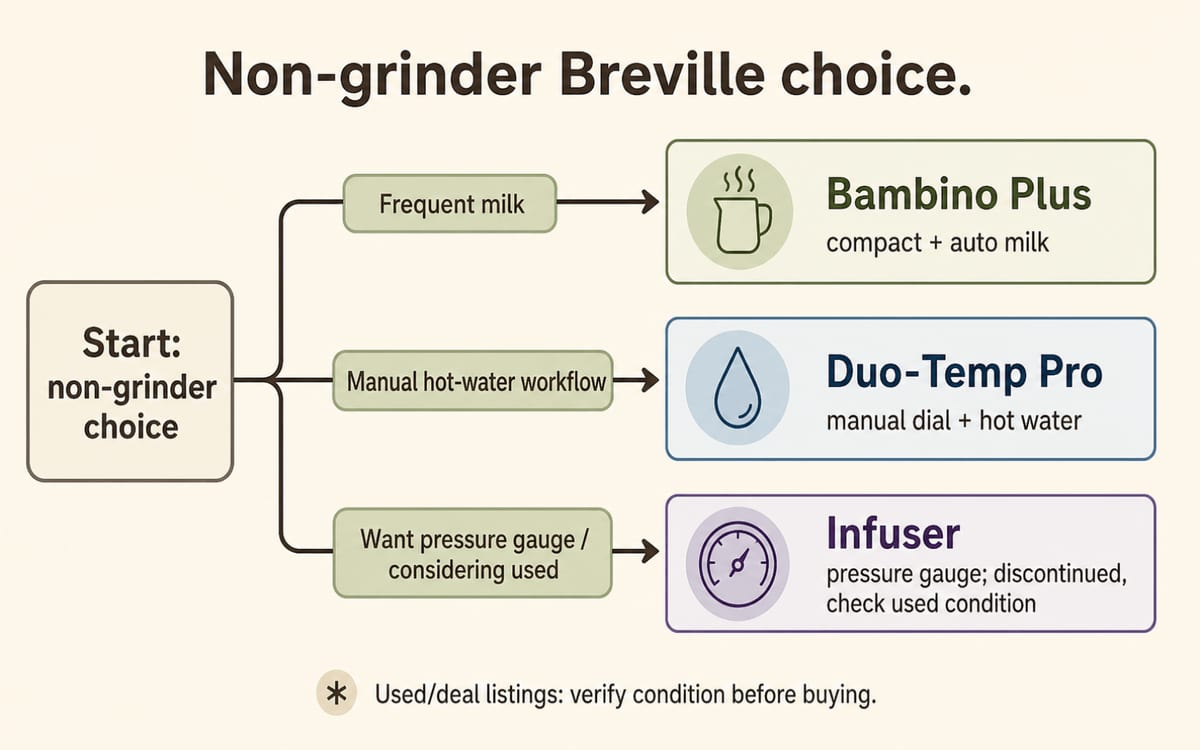
If milk drinks are daily, the Bambino Plus is the easier pick
If your usual order is an occasional cappuccino, flat white, latte, or matcha latte, any of these machines can work and the milk feature should not drive the whole price. Daily multi-drink routines are different: owners describe one or two cappuccinos a day, rising to about four on busy days, and that is where the Bambino Plus gives you the clearest help with milk. If you mostly want steam, hot water, or a couple of americanos rather than milk automation, weigh the Duo Temp Pro’s manual hot-water position before paying extra for the Bambino Plus; if you want frequent cappuccinos, flat whites, family milk steaming, or auto froth, the Bambino Plus is the safer workflow pick. Its hands-free automatic steam wand and automatic purge reduce the amount of milk technique you have to manage before coffee.
The Duo Temp Pro takes more manual milk work. Expect to purge the wand before steaming, create a vortex in the milk, aim for about 140–150°F / 60–65°C, then wipe and purge the wand after texturing. Those extra steps are not a problem if you want to practice, but they matter on busy mornings.
The Infuser can still make sense for a milk-drink household if someone wants more manual espresso work. But if the morning priority is simpler milk handling, the Bambino Plus is the cleaner fit.
For straight espresso, choose feedback or fewer variables
If you mostly drink straight espresso, the decision depends less on milk features and more on how much feedback you want while dialing in shots.
Espresso-focused owners often ask whether the Infuser is a meaningful step up from Bambino-family machines, especially when milk foaming is not the priority. The practical answer is conditional: the Infuser comes up less often in owner discussions than the Bambino family, and the cases behind this page point to situational fit rather than a quality problem. Choose the Infuser if a built-in pressure gauge would help you learn from each shot, not just because more machine variables sound better. Do not assume it will produce better espresso simply because it gives you more variables to learn.
Pick the Bambino Plus if you would rather remove variables and focus on grind, dose, and repeating the same steps. Pick the Duo Temp Pro if you want a manual first machine with a hot-water position on the control dial, or if the price leaves enough room for a capable grinder.
Used or discounted machines need a stricter rule
A sale or marketplace listing can make the Infuser or Duo Temp Pro tempting, but a vague discount is not enough reason to choose either one. If the machines are the same price or within about $50, ignore the gap and pick by daily workflow. If the gap is moderate, choose the machine whose workflow fits and treat the difference as accessory budget. If one machine costs hundreds less, the cheaper machine wins only when the savings leave enough money for a capable grinder and fresh coffee, or when a first-machine buyer is comfortable trading Bambino Plus ease for the Duo Temp Pro’s manual workflow because the deal is genuinely large - in one recurring owner situation, the Duo Temp Pro sold for about half the Bambino Plus price.
Use this rule: a discounted Duo Temp Pro makes sense when the savings protect your grinder budget, the unit is complete, and the manual espresso, steam, and hot-water workflow is the tradeoff you actually want rather than just the machine available nearby. For a quick marketplace decision, check the non-negotiables before you leave or pay: included baskets, Razor tool, milk jug, cleaning accessories, removable 1.8L tank condition, basket condition, steam-wand cleanliness, and whether the price gap is large enough to solve a real need such as grinder budget, hot water, or manual control. Because the Duo Temp Pro is discontinued, also verify warranty or support terms and exact-model compatibility before buying accessories, parts, or bundles.
A discounted Infuser makes sense when you already know you want its learning-oriented controls and the exact unit confirms the features and accessories you expect. If you were leaning Bambino Plus because you want ease, a lower Infuser price does not remove the extra involvement that made you hesitate.
Seasonal-sale waiting should be treated the same way, whether the decision is within an hour, over the next few months, or around a major sale period. Wait only if the expected savings would leave enough money for the grinder or replace missing essentials.
Skip each machine when the mismatch is obvious
Skip the Bambino Plus if you are buying mainly because you want the machine to teach through more visible shot feedback and control. It is the friendlier daily pick, not the most satisfying one for someone who wants the machine itself to be the lesson.
Skip the Infuser if you already feel overwhelmed by espresso decisions. A pressure gauge is only useful if you will watch it patiently and use that feedback to improve your shots.
Skip the Duo Temp Pro if its only appeal is that it is available nearby. Availability is not a feature. Its case is strongest when the lower cost leaves more money for a grinder and fresh coffee, not when it merely gets a machine onto your counter faster.
Final pick for most buyers
Buy the Breville Bambino Plus if you want the most approachable choice among these three, especially for milk drinks and shared household use.
Buy the Infuser if you want a more involved learning machine and a built-in pressure gauge sounds helpful rather than stressful.
Buy the Duo Temp Pro if it is the budget move that lets you put money where it may matter more: into a proper grinder and fresh coffee. For used or old-stock units, the deal only works if the machine is complete, clean, and compatible with the parts or accessories you may need.
Before you buy, verify the few details that can change the choice
Before you pay, check the exact listing or manual for the few details that can change the choice: the Bambino Plus milk jug and sensor-related accessories, the Infuser pressure gauge and included accessories, and the Duo Temp Pro baskets, Razor tool, milk jug, support terms, and exact-model accessory compatibility.
For used listings, the missing-item risk matters most when the price advantage is small. A cheap machine is less compelling if you must immediately replace baskets, a milk jug, cleaning tools, or water filters. Also verify seller warranty or support terms, especially for discontinued, refurbished, or used units.
Common Questions
Which one is best for daily lattes and cappuccinos?
The Bambino Plus is the easiest fit for daily milk drinks because it has a hands-free automatic steam wand and automatic purge.
Should I buy a used Duo Temp Pro?
Only if the lower price protects your grinder budget and the unit is complete, clean, and compatible with the parts or accessories you may need. Check baskets, milk jug, Razor tool, tank condition, steam wand, cleaning items, and warranty or support terms.
Is the Infuser better than the Bambino Plus for straight espresso?
Not automatically. It is a better fit only if built-in pressure-gauge feedback would help you learn from your shots and the unit you are considering actually has that feature.
Should grinder budget change which machine I buy?
Yes. If spending more on the machine forces you into pre-ground coffee or a weak grinder plan, a lower-cost machine plus a better grinder can be the more sensible buy.
What should I verify before buying any of these machines?
Confirm the exact model, included accessories, warranty or support terms, and the features that matter to you. For accessories, parts, or bundles, verify exact-model compatibility before paying.