
What the Bambino Plus gets right for normal mornings
The Bambino Plus is easiest to recommend to someone who wants espresso at home but does not want the machine to take over the kitchen. Its appeal is not that it is the most advanced choice. It is that it removes common friction points.
The convenience case starts with the parts that reduce daily fuss: a 54 mm stainless steel portafilter, automatic steam wand, ThermoJet heating system rated for 3-second readiness, PID temperature control, low-pressure pre-infusion, and volumetric control. The coffee reference is 18 grams, and the package may include a tamper, Razor tool, milk jug, baskets, cleaning tool, and cleaning disc.
This is the best fit for limited counter space, one or two daily drinks, and households where more than one person may use the machine. It is also the safer choice if your real goal is better coffee with fewer daily decisions. Skip it if you can clearly name the problem it will not solve: repeated guest service, a larger 58 mm Breville accessory path, or a specific manual-control goal.
When a Dual Boiler earns the extra space
A Dual Boiler upgrade is worth considering when your current machine limits the number of drinks you can make, especially in owner-reported routines such as two milk drinks every morning, several back-to-back drinks for guests, four-shot days, or small-office use by 4–6 people plus clients. It can also mean adjusting brew temperature for lighter roasts, watching and steering shots as a skill, or wanting the machine itself to be part of the hobby.
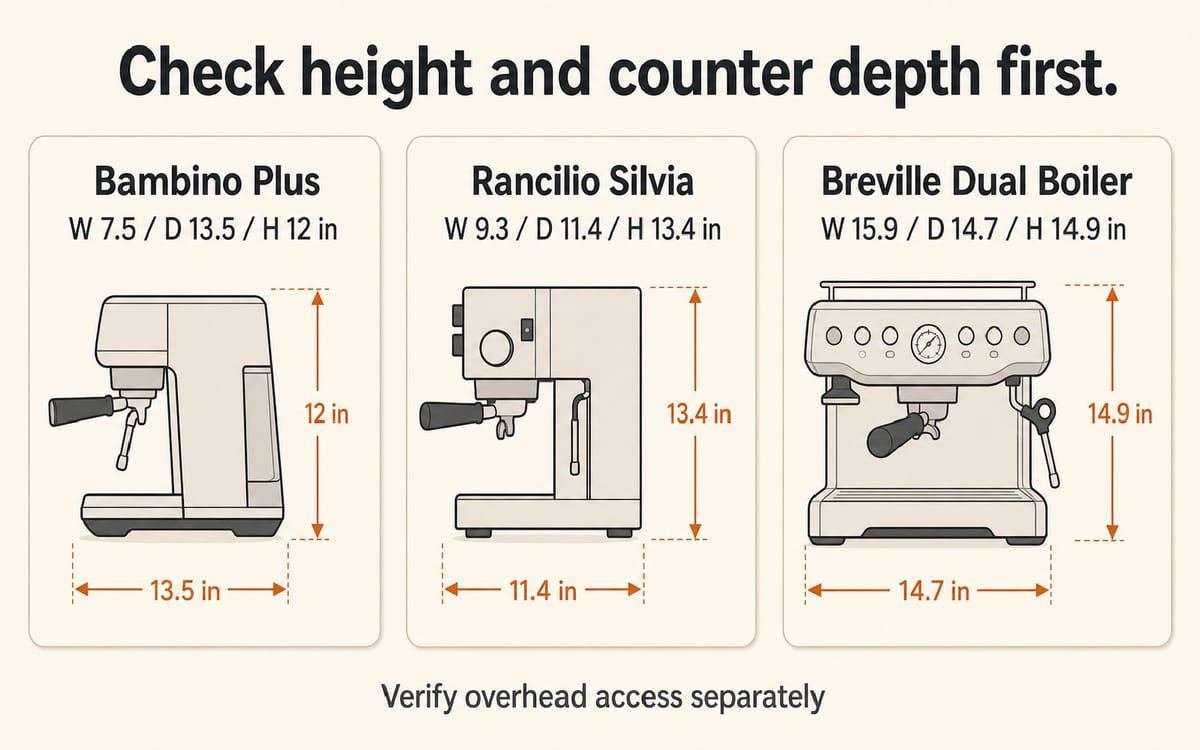
The space check is not minor. The Dual Boiler stands 14.9 inches tall, so it will not fit under a 13.75-inch cabinet. Even if your cabinet is taller, measure for filling, cleaning, tank access, and hand clearance, not just the machine body.
For the Dual Boiler, look for a 58 mm stainless steel portafilter and 58 mm Razor Dosing Tool in the current listing, then make sure the seller's return window is long enough to test fit, heat-up, and your normal drink routine. Do not buy accessories, baskets, or bundles on the name alone, and do not judge the upgrade by the first few days of shots alone: grind setting, dose, and temperature can behave differently on a new machine, so thin or bitter early shots usually mean you need to re-dial the grinder and routine before deciding, within your return window, that the machine was the wrong move.
This path is strongest for buyers with enough space and budget who already know what limitation they are trying to solve; a PID-modified Silvia can cover brew-temperature control, but it does not give you the Dual Boiler's simultaneous brew-and-steam capacity, so be clear about which need is real. If your latte or cappuccino routine is occasional, low-volume, or usually one drink at a time, do not treat milk drinks alone as proof that a higher-cost Silvia or Dual Boiler path is worth it; owner reports make the upgrade case stronger when the price gap buys repeated service, simultaneous brew-and-steam, or controls you will use, while downsizers may reasonably trade that capacity for counter space, faster warm-up, and less to maintain.
Who should still consider the Rancilio Silvia
Choose the Rancilio Silvia if you want a more traditional single-group home espresso machine and are willing to practice with manual controls. It is compact but heavy, with a 2 L tank, 0.3 L coffee boiler, brass brewing group, manual brew-temperature thermostat, stainless steel steam knob and wand, and a 14 kg / 30.8 lb weight.
That matters because the Silvia is not the shortcut choice. You need to be willing to practice with its manual controls. If you want automatic milk, guided controls, or a complete accessory kit, the Silvia is the wrong direction unless the specific listing clearly includes the grinder path, baskets, tools, and support terms you need.
The Silvia’s size can help in some kitchens: the available height is 13.4 inches, with a width of 9.3 inches and depth of 11.4 inches. But height alone is not enough. Check tank access, operating clearance, and whether the specific machine is new, used, modified, or PID-equipped.
For some buyers, the Silvia is a move toward craft. For others, it is a move away from convenience.
A better grinder may help more than a bigger machine
Before spending more on the espresso machine, check the grinder you already have. Can it make small, repeatable espresso adjustments? Can you return to a setting without guessing? Does it leave you fighting the shot even when your prep is consistent?
If the answer is no, protect the grinder budget. A more expensive machine will not automatically fix a bottleneck grinder. This is especially important if the larger machine would consume the money you needed for a capable espresso grinder.
The practical rule is simple: do not upgrade the machine to solve a grinder problem. Upgrade the machine when you can name the machine problem.
Budget beyond the espresso machine
Do not judge any of these by machine price alone. You may need a grinder, scale, tamper, milk pitcher, cleaning supplies, water treatment, replacement baskets, or other small tools. Some buyers already have these; first-time espresso shoppers often do not.
The Bambino Plus is the easiest package to complete if its box includes the milk jug, baskets, tamper, Razor tool, and cleaning pieces you expect. The Dual Boiler path moves you toward 58 mm Breville accessories, so an incomplete bundle can add baskets, tools, and service questions to the real price. For the Silvia, a stock machine, used machine, modified machine, or PID-equipped machine can be a different purchase path, not just a different listing title.
Before choosing the lower-looking price, confirm the warranty coverage, service access, parts access, and return window for that exact new, used, modified, or PID-equipped listing. Those are buyer checks, not assumed advantages. A machine that looks right on the counter may be the wrong long-term fit if support is difficult where you live.
Which one fits your mornings?
Buy the Breville Bambino Plus if you want the most practical home espresso path with the fewest daily obstacles. It is the best fit for small kitchens, mixed-skill households, and people who want espresso drinks without building a full hobby around the machine.
Choose a Dual Boiler if you have enough space and can name the capacity or control problem it solves. Treat it as the obvious upgrade only if the 58 mm package, service support, and return window match the capacity or control problem you are trying to solve.
Pick the Rancilio Silvia if the appeal is learning, not convenience. It is for the buyer who accepts more manual involvement and wants a traditional compact single-group machine rather than automatic milk help.
For most shoppers, the honest choice is simple: Bambino Plus if you want compact convenience, are downsizing from a larger machine, or need a safer return-window choice; Dual Boiler if you can justify the larger capacity and 58 mm package; Silvia if you want the craft. The best upgrade is the one that matches the mornings you actually have.
Common Questions
Is the Breville Bambino Plus enough for daily home espresso?
Yes, if you mostly make one or two drinks and value compact size, 3-second readiness, automatic milk, and simple controls. It is less compelling if you regularly make several drinks in a row or want a larger manual-control path.
Will a Breville Dual Boiler fit under a 13.75-inch cabinet?
No. The available Dual Boiler height is 14.9 inches, before any extra clearance for filling, cleaning, or daily access.
Does the Bambino Plus use 54 mm or 58 mm accessories?
The Bambino Plus uses 54 mm accessories, including a 54 mm stainless steel portafilter. For a Dual Boiler, check the current listing for 58 mm included accessories. Confirm the Silvia portafilter diameter before buying baskets or accessories.
Is the Rancilio Silvia easier to use than the Bambino Plus?
No. The Silvia is the more manual traditional option, with a brass brew group, manual brew-temperature thermostat, and stainless steam controls. Choose it for involvement, not automatic convenience.
Should I upgrade my grinder before my espresso machine?
If your grinder cannot make small, repeatable espresso adjustments, or your shots turn thin, bitter, fast, slow, or inconsistent after switching machines, protect the grinder budget first and troubleshoot grind and prep before buying a bigger machine. A bigger machine will not automatically fix a grinder bottleneck.