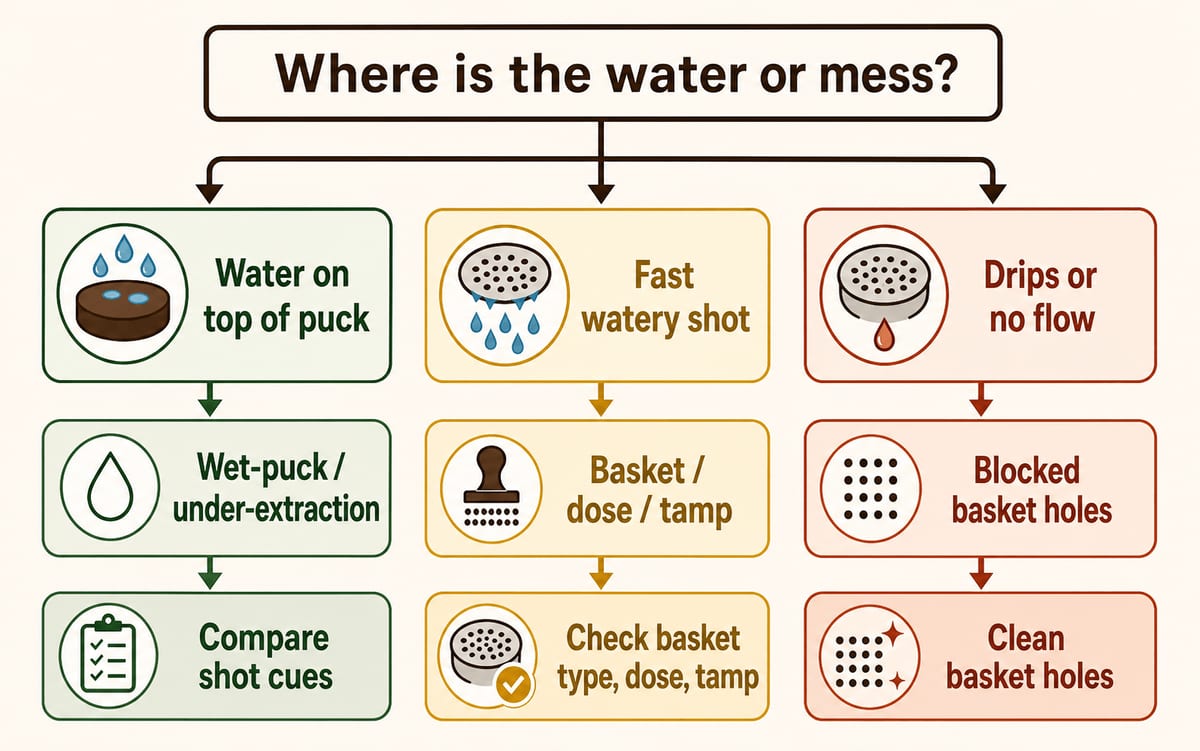
Start with where the water or coffee is left
If the puck breaks apart but the espresso still looks drinkable, first note where the water or sludge is left. On the Breville Bambino Plus, that mess can mean your shot is under-extracted, but it can also be mostly a cleanup problem. The useful move is to compare the puck with the shot, not to chase a perfectly dry cake by itself.
Find the main place the mess appears before changing grind. Owners with this symptom often lose time because water on top of the puck, coffee stuck to the shower screen, and water left after a blank shot all get treated as the same fault.
| What you see | Do this next | What it usually means |
|---|---|---|
| Water on top of a spent puck | Compare shot flow, crema, color, and taste | A fast, pale, or weak shot points to under-extraction |
| Muddy coffee in the basket or portafilter | Check basket type, dose, tamp, and trim | A recent basket change points to a basket, dose, or grind mismatch |
| Grounds on the rim or edge mess | Wipe the rim and control dose height | The portafilter still seals poorly or mess stays at the edge |
| Coffee stuck to the shower screen | Clean the group head and shower-screen area | The puck keeps lifting out of the basket |
| Water only after a blank shot | Retest with coffee | If the coffee shot is normal, treat blank-shot water as rinse water; if the spent puck is still wet, judge it with the shot cues |
| Espresso only drips or will not flow | Check tank seating, basket holes, dose, tamp, grind, and descale status | Restricted flow usually points to tank seating, blocked holes, too-fine grind, too much coffee, too-hard tamp, or descale need |
Blank shots are not spent-puck evidence
The Bambino Plus manual supports running water through the portafilter without coffee for rinsing and warming. That means water left after an empty shot is not the same observation as a wet spent coffee puck.
Use coffee, the intended basket, and a known dose before making puck conclusions. A blank shot can tell you whether water flows through the machine, but it cannot tell you whether your coffee bed is behaving well after extraction.
Judge the shot before chasing a dry puck
Breville’s own extraction cues are cup and flow cues. A correct-looking shot starts flowing after about 8–12 seconds, moves slowly like warm honey, has golden-brown crema with fine texture, and produces dark-brown espresso. A dry puck is not listed as the proof of a correct shot.
Under-extraction looks different: flow starts early, around 1–6 seconds, runs fast like water, the crema is thin and pale, the espresso is pale brown, and the taste may be sharp, weak, or watery. A wet puck paired with those signs is worth fixing.
So split your goal. Better espresso means adjusting grind, dose, tamp, and basket match until the shot cues improve. Easier cleanup means controlling dose height, rim cleanliness, and basket cleanliness, while accepting that the Bambino Plus may not knock out a dry, compact puck every time.
After a basket swap, compare it with the stock basket
Wet pucks often show up right after a basket change. That does not prove an aftermarket or precision basket is bad, but it does mean your old dose and grind may no longer be a fair test.
Use the stock basket as a control before changing the grind, tamp, or accessories. The Bambino Plus comes with the 2-cup single-wall basket installed. Single-wall baskets are intended for freshly ground whole beans, while dual-wall baskets are for pre-ground coffee or older beans. The manual’s dose ranges are 8–11 g for the 1-cup basket and 16–19 g for the 2-cup basket.
After switching basket type or size, reset the basics: match the basket to the coffee, stay within the dose range, adjust grind for flow, and change one variable at a time. If the stock basket behaves better, the new basket may simply need a different dose, grind, or coffee match rather than pointing to a machine fault.
Dose height, tamp, and rim cleanup come before accessories
Control the coffee bed before buying or blaming tools. Breville gives a practical tamp range of 22–33 lb, or 10–15 kg. After tamping, the top edge of the tamper’s metal cap should sit level with the top of the filter basket.
Then trim the dose with the Razor tool: insert it until the shoulders rest on the basket rim and rotate it back and forth to remove excess grounds. Wipe loose coffee from the basket rim before locking in the portafilter. That rim matters because stray grounds can interfere with the seal and leave edge mess that looks like a broader puck problem.
A common dead end in owner reports is assuming a distribution tool, puck screen, spring tamper, or dose check will guarantee a dry puck. If a tool makes the bed neater but the puck still knocks out muddy, go back to dose height, rim cleanliness, basket match, and shot flow before blaming the machine.
Stuck pucks need a location check
A puck that sticks to the basket is not quite the same problem as a puck that sticks to the shower screen. If coffee stays in the basket in wet pieces or only comes out after hard knocks, focus first on dose, tamp, basket match, and whether the basket holes are clean.
If the puck or wet grounds cling to the shower screen, clean the group head interior and shower screen with a damp cloth. Rinse the filter baskets and portafilter under hot water after use. If holes in the filter basket are blocked, use the pin on the provided cleaning tool to clear them.
You can also periodically run hot water through the locked-in portafilter with the basket installed and no coffee. That is a cleaning and blockage check, not a blank-shot test of puck quality.
Drips, no flow, or repeated watery shots call for machine checks
Stop treating the puck as the main problem when espresso only drips, no water comes through, or flow stays abnormal. Check that the tank is filled and pushed down completely into place. Then check for a grind that is too fine, too much coffee in the basket, tamping too hard, blocked basket holes, or a needed descale cycle.
If the shot starts fast, runs watery, and tastes weak, go the other direction: use a slightly finer grind, increase dose within the basket’s range, tamp properly, and trim excess with the Razor.
When you have already controlled basket choice, dose, tamp, rim cleanliness, basket holes, cleaning, descaling, beans, and grind, do not keep repeating the same prep changes forever. Document what the shot does, what lights or flow problems appear, and which baskets you tested, then contact Breville support or request service if abnormal flow, leaks, or unresponsive controls remain.