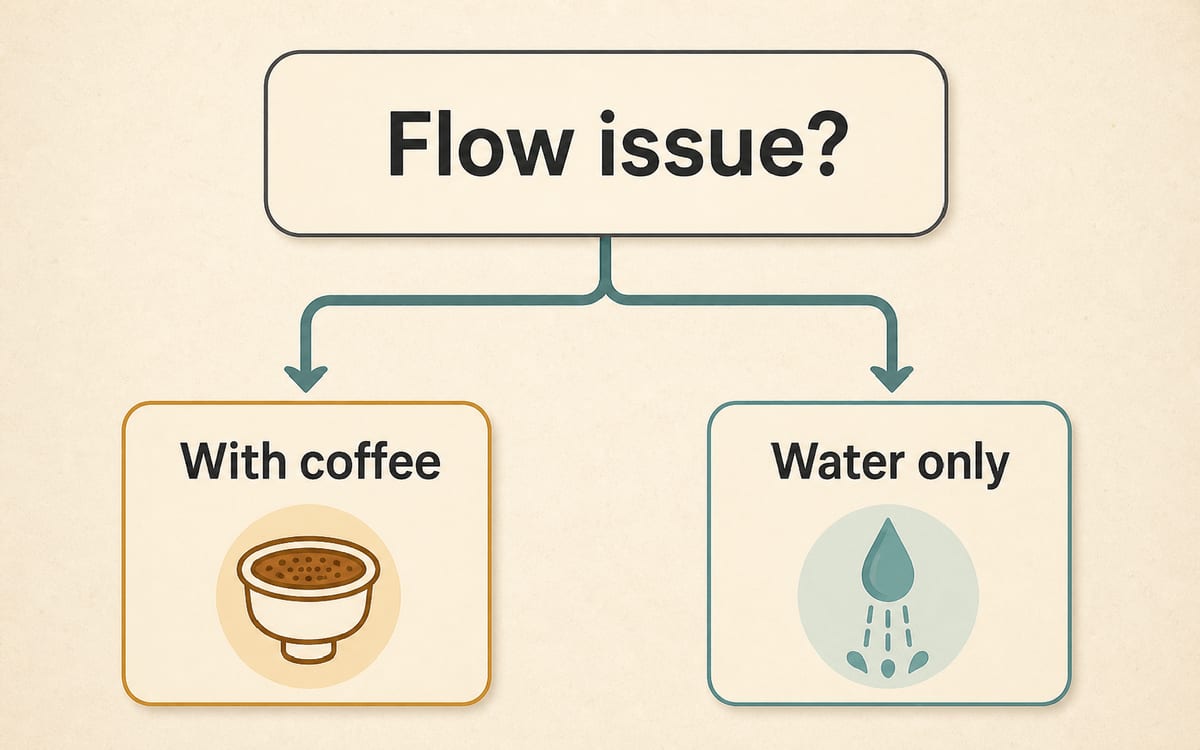
Is the uneven shot coming from the puck or the machine?
One Bambino Plus spout runs amber while the other only drips pale liquid, or the stream starts thick and then turns thin halfway through. That sight is useful, but only if you catch it before changing three settings at once. The first job is not to decide whether the machine is bad. It is to find out whether the odd pattern needs coffee in the basket to appear.
Before adjusting grind, dose, or tamp, write down the basics: when the color or flow changes, which spout is affected, how long it takes from button press to first flow, dose, yield, basket type, coffee freshness, and whether you recently cleaned, descaled, or changed hardware.
Then run a short no-grounds rinse with the basket and portafilter in place. Breville’s manual supports running hot water through the machine this way, and it gives you a clean comparison: check the outlets with no grounds first, then load coffee and judge the puck.
| What you see | Check now | What changes your next move |
|---|---|---|
| Water-only flow looks even, but coffee flow is one-sided, pale, or pulsing | Basket type, dose, grind, tamp, distribution, and freshness | Start with dose, grind, tamp, distribution, and freshness |
| Water-only flow is weak, uneven, pulsing, or mostly from one side | Tank seating, blocked holes, group head, shower screen, cleaning, descale, or priming | Stop blaming tamp angle until water flow looks normal |
| The pattern began right after cleaning or descaling | Shower-screen seating, group-head cleanliness, and water-only behavior | If it began after cleaning or descaling, recheck that work before dialing in again |
| The pattern began after a basket, portafilter, insert, or puck screen change | Compare the new basket or portafilter with the old one if you still have it | Do not assume grind is the only changed variable |
Owners with this symptom often report changing grind, dose, shot buttons, or coffee several times without learning much. The water-only check prevents that loop.
Run a no-grounds rinse with the portafilter installed
Keep the basket and portafilter in place, run hot water briefly, and look for two steady, similar streams; if you see that, load coffee next, but if one spout is weak, pulsing, or mostly dry, fix water flow first.
If water-only flow is normal, move on to a coffee-loaded shot with the same basket and portafilter. Then work through basket, dose, grind, tamp, distribution, and freshness one at a time.
If water-only flow is weak or uneven, check the simple supply and blockage items first. The water tank should be filled, fully inserted, and locked into position. Basket holes can be blocked and may need clearing with the cleaning-tool pin. The group head interior and shower screen should be wiped with a damp cloth. If flow is weak or inconsistent and scale is likely, descale according to the manual instead of trying to fix the symptom with finer or coarser grinding.
Coffee-only unevenness points back to basket, dose, grind, and tamp
Once water-only flow looks even, identify the basket before reading too much into the color of the stream. The Bambino Plus uses 1 Cup and 2 Cup baskets with official dose ranges of 8–11 g for 1 Cup and 16–19 g for 2 Cup. Single-wall baskets are intended for freshly ground whole beans, while dual-wall baskets are meant for pre-ground or older coffee. Breville also gives a fresh-bean window of 5–20 days after the roasted-on date, and says pre-ground coffee should be used within a week of grinding.
Those details matter because a pale, fast, watery-looking shot can be under-extracted rather than a machine fault. Breville describes a correct shot as starting after about 8–12 seconds, flowing slowly like warm honey, with golden-brown fine crema and dark-brown espresso. Under-extracted shots start sooner, around 1–6 seconds, and run fast and watery with thin pale crema. Over-extracted shots start after more than 12 seconds and may drip, with darker, spotty crema.
For fast, pale, or watery coffee-only flow, change one variable at a time: grind slightly finer, raise the dose if it is low, and tamp in Breville’s 22–33 lb range. After tamping, the Razor trimming tool is used with its shoulders resting on the basket rim; rotate it to trim excess coffee. Wipe grounds from the rim before locking in the portafilter so a dirty rim is not masquerading as an extraction problem.
One-sided spouted flow needs repeat checks, not endless grind changes
A one-sided spouted shot can show up several ways: one outlet nearly dry, one fast stream while the other drips, one side watery, or one side slower and darker. Owners often suspect tamp angle or channeling immediately, and that may be part of it when water-only flow is even. But one spout misbehaving does not automatically prove poor tamping, and it does not automatically prove a machine fault.
Repeat the shot only after making one change. Note whether the same side stays affected. Clean the basket holes and the spouts. If you have another compatible basket or the original portafilter, compare both water-only flow and a coffee-loaded shot using the same dose.
If the symptom follows the coffee puck, your next useful work is distribution, grind, dose, tamp, and freshness. If the same side stays weak during water-only checks after cleaning, the problem is no longer just one unlucky puck.
Uneven water after cleaning or descaling means recheck the machine first
If the water turns weak, pulsing, or one-sided after cleaning or descaling, stop adjusting the grind and recheck the parts you handled. Look for changes you can verify: parts not seated as shown in the manual, residue on the shower screen or group head, or water-only flow that still turns weak, pulsing, or one-sided.
Check that the parts you removed are seated as the manual shows, wipe the shower screen and group head, and run water without grounds again. Do not treat cleaning and descaling as the same fix: the Bambino Plus signals the automatic cleaning cycle with alternating 1 Cup and 2 Cup lights after 200 extractions. Use descaling when the issue matches Breville’s no-water, weak-flow, or low/inconsistent-pressure symptoms.
If the water pattern was normal before maintenance and uneven afterward, compare before you keep dialing in coffee. A post-maintenance water problem should not be treated like ordinary bean adjustment.
Compare a new basket or portafilter with the old one
If the odd flow began after you installed a new basket, portafilter, insert, or puck screen, compare that part with the one you were using before. The manufacturer does not give a universal identification cue for aftermarket baskets or puck screens, so check the part label, packaging, seller documentation, or machine manual before you assume the part matches the original basket.
Return to the old basket or portafilter if you still have it. Run the same water-only check, then a coffee-loaded shot with the same dose and coffee. If you get normal results with the old basket or portafilter but see diagonal flow, side-sticking water, low crema, or one-sided output with the new part, inspect the new basket holes, spouts, insert seating, and fit before making more grind changes.
Stop home troubleshooting when water-only flow still stays weak
Keep working on puck prep only when the unevenness appears with coffee and the no-grounds water flow is even. That is the right time to tune basket choice, coffee freshness, dose, grind, tamp, distribution, and yield.
Stop adjusting coffee and contact Breville support or a repair service when weak, pulsing, or one-sided water-only flow persists after the manual’s user checks: tank seated and filled, basket holes cleared, group head and shower screen wiped, cleaning or descaling done when indicated, and any changed basket or portafilter compared if available. Bring your notes: affected side, water-only result, basket type, dose, timing to first flow, recent maintenance, and any changed parts.