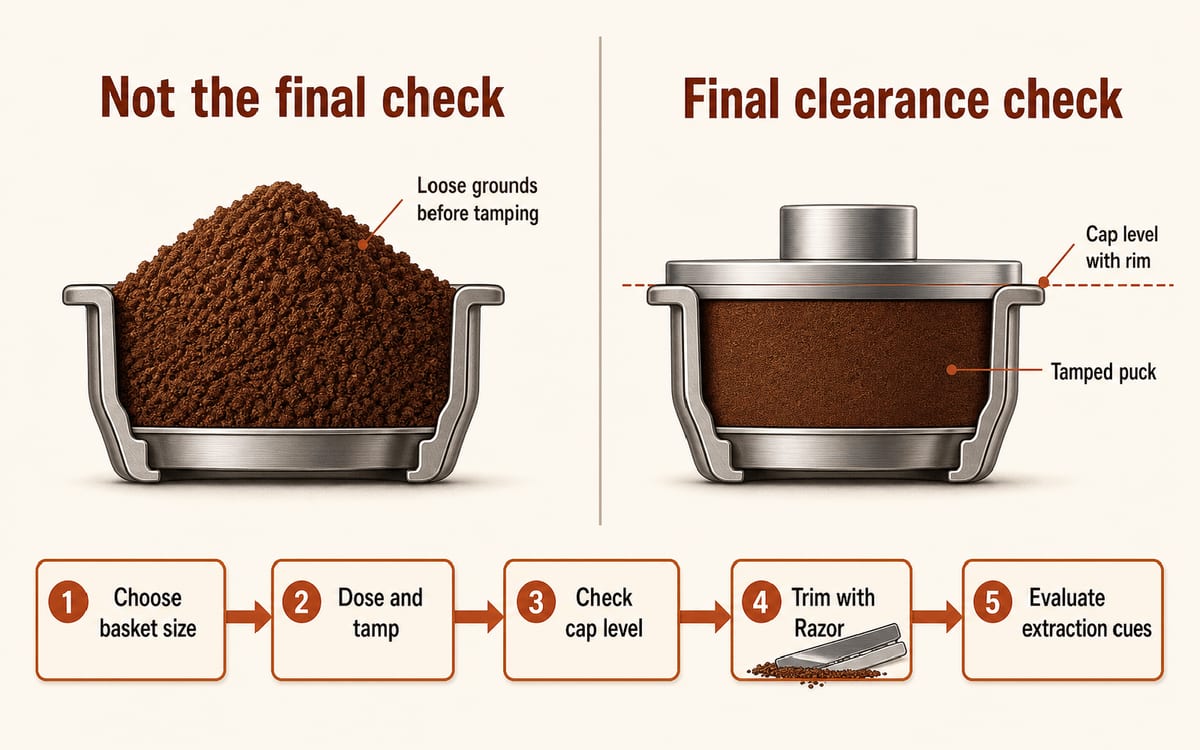
Why 14 g can fit when 18 g sits too high
If the portafilter fights the group head, do not try to solve it with one more hard tamp. The common culprits are the basket you are using, the coffee’s volume after grinding, the height of the puck after tamping, and any extra stack height from a puck screen. The fastest way through it is to stop treating the gram target as the proof and check the fitted, tamped coffee instead.
Owners with this symptom often get stuck around 18 g: loose grounds mound over the basket, the tamp feels cramped, the portafilter fights the group head, or a puck screen seems to touch too early. Others see the opposite problem, where a rated dose looks low and tempting to overfill. Whether the basket looks overfilled or oddly low, start the same way: choose the right basket for your coffee, then judge the puck after a normal tamp.
| What you see | First check | Likely meaning | Next move |
|---|---|---|---|
| Loose grounds mound high before tamping | Tamp normally, then check height | Messy loose coffee is not the final fit | Trim after tamping before reducing dose |
| Tamped puck stays high or the portafilter will not seal | Dose and rim clearance | The basket is still too full | Lower the dose; do not add tamp force |
| Basket looks low after tamping | Flow and taste after clearance is confirmed | It may be under-dosed, but not automatically | Increase only within a fit-checked range |
| Puck screen catches, tilts, or seems to reduce room | Test the same dose without the screen | The accessory may be stealing headspace | Remove it for testing or verify its dimensions |
| Shot drips or stops after the puck fits | Grind, dose, tamp, tank, and basket holes | Slow flow is not automatically pressure failure | Check the flow causes one by one |
The Bambino Plus manual gives the 1 CUP basket as an 8–11 g starting range and the 2 CUP basket as a 16–19 g starting range. Those numbers are useful, but they are not a guarantee that every coffee, roast, grind, or puck-screen combination will leave enough room at the top of the basket.
That is why 14 g can be a reasonable practical dose with one coffee while 18 g is workable with a different roast, grind, or puck-screen fit. Grams measure weight, not how much space the ground coffee occupies in the basket. Roast, freshness, grind, and how fluffy or clumped the grounds are can all change the basket volume you see at the counter.
Match the dose to the basket in your portafilter
Identify the basket before deciding whether the dose is wrong. The manual separates the baskets by size and coffee type: 1 CUP or 2 CUP for capacity, and single-wall or dual-wall for fresh beans versus pre-ground or older coffee.
Use the 1 CUP basket for a single cup, with 8–11 g as the starting range. Use the 2 CUP basket for two cups, a stronger single cup, or a mug, with 16–19 g as the starting range. Single-wall baskets are the normal choice for fresh whole beans. Dual-wall baskets are the supported choice for pre-ground coffee or older beans.
This matters because a reader trying to fit 18 g into the wrong basket is solving the wrong problem. It also matters for pre-ground coffee users: if you cannot change grind size, basket choice, dose, tamp, and headspace become the checks you can still control.
Judge the puck after a normal tamp
Do not decide from the loose pile. Dose near the relevant range, distribute as evenly as you can, and tamp straight down with normal pressure. Breville gives 22–33 lb / 10–15 kg as the tamp range. More force is not the fix for a basket that is actually overfilled.
After tamping, use the Razor trimming tool as the height check. Insert it until its shoulders rest on the basket rim, then rotate it back and forth to remove excess coffee. The point is not to rescue any dose at any cost; it is to bring the tamped puck to a level the machine is designed to accept.
Wipe loose grounds off the basket rim before locking in the portafilter. Grounds on the rim can cause a poor seal, and espresso may run around the portafilter edge. The portafilter should be fully inserted and rotated until you feel resistance, not forced against a puck that is still too tall.
Reduce a high puck before changing grind
A tamped puck that remains too high after normal tamping and Razor trimming is still a dose and headspace problem. Lower the dose first. Do not grind finer mainly to make more grams fit, and do not lean harder on the tamper to compress an oversized puck into place.
This is the common dead end in owner reports: the basket looks too full, so the next attempt is a finer grind, a different tamper, more pressure, or an assumption that the machine should accept 18 g because the basket range reaches 19 g. Those moves can leave the puck high and make the shot harder to read.
Once the puck fits, then grind changes become easier to interpret. Before that, a choking shot may simply be too much coffee or too little clearance, not a meaningful pressure diagnosis.
Do not fix extra headspace with a big overdose
An underfilled-looking basket can be just as misleading as an overflowing one. If the tamped puck sits lower than expected, increase dose only within a range that still passes the fit check: normal tamp, Razor trim, clean rim, and a portafilter that seals without drama.
Large overdosing just to make the basket look fuller can create its own trouble. Owner reports include the pattern of pushing well above a basket’s stated dose and still ending up with slow flow or a watery puck. The better test is whether the shot behaves after the puck fits.
For a correct extraction, Breville’s cue is flow beginning after about 8–12 seconds, moving slowly like warm honey, with golden-brown crema. If the fit is good but the espresso starts after 1–6 seconds and runs fast like water, move toward finer grind or a careful dose increase that still leaves clearance.
Puck screens need their own clearance check
A puck screen adds height to the stack inside the basket. The official Bambino Plus instructions do not give a puck-screen clearance number, so do not treat a screen that catches, tilts, pools water, or seems to touch early as proof of a pressure problem.
Test the same dose without the screen. If the puck trims cleanly, the rim stays clean, and the portafilter locks normally without it, the screen is part of the clearance question. Either lower the dose enough to account for the screen or verify the accessory’s dimensions and compatibility with its maker.
If the screen still interferes after the puck dose is reduced, stop adjusting grind and tamp to compensate for the accessory. The problem to solve is physical fit, not extraction tuning.
Flow problems after clearance is corrected
Once the puck fits and the portafilter seals, use the shot behavior to decide what to check next. If flow starts after 12 seconds, drips, or stops, the manual-supported checks include grind that is too fine, too much coffee, tamping outside the normal range, blocked basket holes, an unseated water tank, or scale.
Check the simple physical items before assuming the machine has failed. Push the water tank fully down so it locks into place. If the basket holes are blocked, use the pin on the provided cleaning tool. Keep the filter baskets, portafilter, group-head area, and shower screen clean; residue can make a good dose behave badly.
Multiple thin streams from the portafilter point more toward uneven preparation than basket capacity. Distribute the grounds evenly, tamp straight down without tilt, and avoid tapping after tamping. If the puck fits, the rim is clean, and flow still points clearly fast or slow, you have moved past the headspace question and into ordinary grind, dose, cleaning, or water-path troubleshooting.